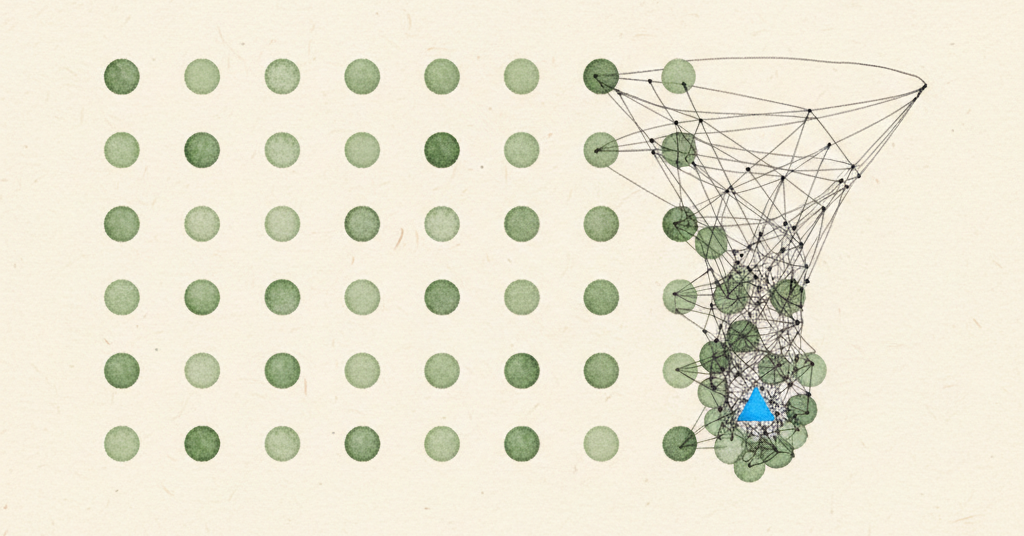
AI brand recommendations are more concentrated than traditional search results because they are not a list of links, but a synthesis. Generative AI models build a single, narrative answer by drawing on a small pool of sources they deem most authoritative and citable. This process inherently favours established entities with deep, structured data, squeezing out the long tail of brands that can still win visibility in a standard search results page.
For years, winning in search meant ranking on page one. Now, with the rise of generative search retail, the goal is shifting. It's no longer just about ranking; it's about being cited. When a buyer asks an AI for a recommendation, your brand is either part of the answer or you are invisible. This represents a fundamental change in ecommerce product discovery, one where visibility behaves more like share-of-consideration than a simple search position.
The benchmark: 40.1 out of 100
40.1 / 100
Average AI Discovery Score
Source: The UK Home & Interiors Digital Growth Benchmark 2026. N=75 UK retailers.
The average AI Discovery score for a UK home and interiors brand is 40.1 out of 100. This is the lowest-performing capability of the six we measure in our cornerstone study, The UK Home & Interiors Digital Growth Benchmark 2026. For comparison, the average score for traditional Organic Discovery is 87.3. The gap shows how unprepared the sector is for the shift from search to synthesis.
How we derived this benchmark
This number comes from our proprietary research, where we scored 75 UK home and interiors retailers against 54 distinct criteria. Our AI Discovery pillar assesses a brand's visibility and citability within generative AI models. We test this by running a series of commercial queries and analysing which brands are recommended, how they are described, and the sources used to justify the recommendation.
This is an outside-in analysis, meaning we assess what a potential customer sees, not what a business says it does. The confidence level is high; the data set is broad, covering multi-category pureplays, omnichannel retailers, and specialist DTC brands from £5m to over £1bn in revenue. You can read more about our full scoring system in the benchmark methodology.
Why are AI brand recommendations more concentrated?
AI models are designed to minimise risk and deliver a single, confident answer. They do this by relying on sources with strong signals of authority and trust. This creates a feedback loop where established, well-structured brands like IKEA (99.2 overall score) and John Lewis (98.8) are cited repeatedly, reinforcing their authority and making it harder for others to break in. Unlike a search engine result page with 10+ slots, an AI answer often synthesises information from just 3-5 core sources.
Performance bands: Healthy, Watch, or Broken
With an average score of 40.1 and a median of 37.5, the typical brand we analysed falls into the 'Broken' or low 'Watch' category. This holds true regardless of business model; AI Discovery was the weakest pillar for every peer group. The top performers are outliers, not the norm.
| Band | Score Range | What this means for your business |
|---|---|---|
| Healthy | 70 – 100 | Your brand is a primary, citable source for AI. You are frequently recommended and seen as an authority. |
| Watch | 40 – 69 | Your brand has some visibility but is not a go-to source. You appear inconsistently in recommendations. |
| Broken | 0 – 39 | Your brand is effectively invisible to AI engines. You are not considered a citable source for products or advice. |
Three common reasons a business scores below 40
- Unstructured Expertise. Your business has deep knowledge, but it's presented as marketing copy or narrative blog posts. AIs struggle to parse this for hard facts. They need citable data points—dimensions, materials, company history—presented as structured information.
- A Weak 'Entity' Footprint. AI models see brands as 'entities' with defined attributes. If your brand's profile in Google's Knowledge Graph and other data sources is thin, the AI has low confidence in who you are and what you do. It will favour a competitor with a clearer digital identity.
- Lack of Citable Assets. Many brands in this sector lead with beautiful imagery, but current AI models build trust from text, data, and links. Without a solid foundation of factual, text-based content about your company, products, and principles, you give the AI little to work with. This is a key reason why many visually-led, smaller brands may vanish in AI search.
What to change first, and how long it takes to show
The first step is to make your core business and product information citable. Focus your effort on your 'About Us' page and your main product category pages, as these are foundational assets for establishing authority.
Treat these pages less like marketing brochures and more like encyclopedia entries. Rewrite them to include simple, declarative sentences stating your founding date, mission, operational headquarters, and key product differentiators. Then, work with your developers to implement Schema.org markup. This structured data is code that explicitly tells AIs what your content is. Use Organization schema for your company information and Product schema for your goods.
This work can be completed in a single development sprint. You should see search engines begin to register these changes within weeks. However, building enough authority to be consistently cited in AI recommendations is a longer project. We typically see early signals within 3 months, with meaningful, consistent visibility taking 6-9 months to achieve. If this challenge is a priority, our AI Discovery programme is designed to accelerate this process.